- Try this Sample Quiz.
- There are 10 questions to complete in 12 minutes
- You will be given an overall mark at the end of the quiz, as well as a mark for each category
- This quiz is a mix of 10 questions taken at random from the 1050 questions in the numeracy program
- Use the hint if you get stuck
- Check where you went wrong by clicking View Questions.
Quiz Summary
0 of 10 Questions completed
Questions:
Information
You have already completed the quiz before. Hence you can not start it again.
Quiz is loading…
You must sign in or sign up to start the quiz.
You must first complete the following:
Results
Results
0 of 10 Questions answered correctly
Your time:
Time has elapsed
You have reached 0 of 0 point(s), (0)
Earned Point(s): 0 of 0, (0)
0 Essay(s) Pending (Possible Point(s): 0)
| Average score |
|
| Your score |
|
Categories
- Measurement 0%
- Number 0%
- Ratio & Rates 0%
- Statistics 0%
| Pos. | Name | Entered on | Points | Result |
|---|---|---|---|---|
| Table is loading | ||||
| No data available | ||||
- 1
- 2
- 3
- 4
- 5
- 6
- 7
- 8
- 9
- 10
- Current
- Review / Skip
- Answered
- Correct
- Incorrect
-
Question 1 of 10
1. Question
Category: MeasurementSkill (Level 2): Reading whole number scales in a familiar context.
What is the length of the paper clip shown below?
(Units are centimetres)
 CorrectIncorrect
Hint
- The paper clip extends from the 36-centimetre mark to the 42-centimetre mark.
- Count how far it is from 36 to 42 by going 37, 38, 39, etc…42 or subtract 36 from 42.
-
Question 2 of 10
2. Question
Category: NumberSkill (Level 2): Writing, Reading and interpreting very small and very large numbers.
A nanosecond is one billionth of a second.
Which of the following is a nanosecond?
CorrectIncorrectHint
- One billion is one thousand million.
- Now view this as a fraction.
-
Question 3 of 10
3. Question
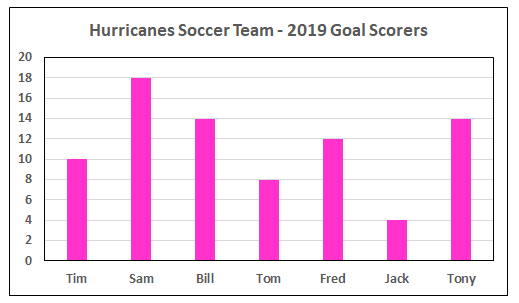
Category: StatisticsSkill (Level 2): Interpreting information from a column graph to solve a problem.
The goals scored by players during a soccer season are graphed below.

Which player scored six goals less than Sam?
CorrectIncorrectHint
- Check out the height of the column that represents Sam.
- Now find the column that has a height six less than Sam’s column.
-
Question 4 of 10
4. Question
Category: MeasurementSkill (Level 2): Convert between standard metric units of length, mass and capacity to solve a problem
A two-litre jug of water is poured into six 250-millilitre glasses.
The remaining water is poured into smaller 100-millilitre glasses.

How many of the smaller glasses are filled with water?
CorrectIncorrectHint
- Convert the 2 litres to millilitres.
- Calculate the number of ml poured into six large glasses by multiplying six by 250.
- The remaining water will be poured into the smaller glasses.
-
Question 5 of 10
5. Question
Category: Ratio & RatesSkill (Level 3): Convert between standard metric units of length to establish the correct scale.
A map has a scale of 1 centimetre representing a distance of 2 kilometres in real life.
What is the appropriate scale for the map?
CorrectIncorrectHint
-
- We need to convert 2 kilometres to centimetres.

-
Question 6 of 10
6. Question
Category: MeasurementSkill (Level 2): Convert between standard metric units of length, mass or capacity to solve a multi-step problem.
Baby John weighed 3100 grams at birth.
It is estimated that in the next 12 months, his weight will increase threefold.

What will John’s estimated weight be in 12 months?
CorrectIncorrectHint
- Times means multiply. Therefore 3100 x 3 = ?
- If your answer from step 1 is not one of the choices, you will need to convert grams to kilograms.
- Note. 1000 milligrams = 1 kilogram
-
Question 7 of 10
7. Question
Category: Statistics Skill (Level 3): Calculate mean, median, mode or range for sets of data and interpret these statistics in the context of the data.
Joseph wants to buy a pair of runners.
He visits five stores and notes the prices on offer for the same style of shoe.
The prices are listed as: $59, $58, $58, $64 and $66.
What is the mean (average) price of the shoes?
CorrectIncorrectHint
The mean is a measure of central tendency. It is also known sometimes as the ‘average’.
-
Question 8 of 10
8. Question
Category: MeasurementSkill (Level 2): Interpreting a diagram to calculate the area of a shape in a familiar context.
A plan of Nick’s backyard is shown below.
The area of the lawn in the middle of the yard is 16 m². The rest is paving.

What is the area of paving?
CorrectIncorrectHint
- Nick’s lawn in the middle of his yard takes up four squares, and there are 16 m² of lawn.
- This means that each square in Nick’s backyard is worth four m² (16÷4).
- You can now work out the area of paving.
-
Question 9 of 10
9. Question
Category: NumberSkill (Level 2): Applying the four operations of small numbers to solve a problem in a money context.Mulching the garden in the summertime with straw is an excellent way of saving water.
A bale of straw costs $8.50, and the delivery charge is $35.
Olivia spent $137 in total.

How many bales of pea straw did she buy for the garden?
CorrectIncorrectHint
- It costs $35 to have the straw delivered.
- Calculate the amount spent on straw by subtracting the delivery costs from $137.
- The total bales purchased is found by dividing the answer to step 2 by the cost of a bale of straw.
-
Question 10 of 10
10. Question
Category: NumberSkill (Level 3): Comparing and ordering percentages and fractions in a measurement context.
Michael’s results of his last four science tests are listed below:
13/20 14/25 73% 34/50
Drag and drop Michael’s lowest and highest percentage scores to their correct positions.
Sort elements
- 14/25
- 73%
- 13/20
- 34/50
-
lowest % score is
-
highest % score is
CorrectIncorrectHint
- To compare the four scores we need to change all scores to a mark out of 100.
- 13/20 (multiply top and bottom by 5).
- 14/25 (multiply top and bottom by 4).
- 73% = 73/100 (73/100 is the same as 73%).
- 34/50 = (multiply top and bottom by 2).